Berlin’s Jewish history is a complex mosaic pieced together from the earliest historical records through the horrors of WW2, to today’s continued rebirth of its vibrant Jewish community.
The first known historical records of Jewish settlement in Berlin date back to 1295. The early Jewish settlers built their community near Rosenstrasse and faced a variety of challenges, including periods of expulsion and persecution. However, there were periods where the Jewish people contributed significantly to the city’s cultural and economic life.
The area that Berlin Jews called home prior to WW2 was centered near the Hackescher Markt area and along Grosse Hamburger Strasee, where many important Jewish buildings and institutions were built and then later destroyed during WW2.
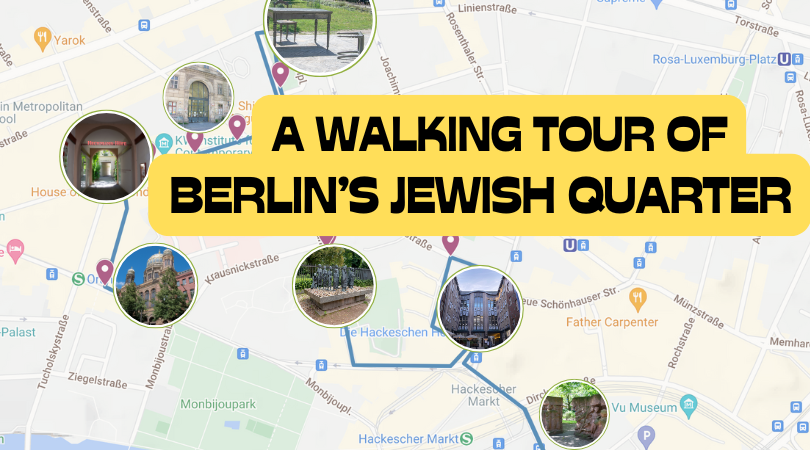
To get a basic understanding of the history of Berlin’s Jewish people, we’ve put together a small walking tour that will take you back in time, while showing you how this part of Berlin’s Mitte area has risen from the darkest parts of modern history into a thriving lively neighborhood filled with cafes, shops, and young professional families.
Before we begin, this tour is meant to go at your own pace. Take time to stop along the route to grab a snack, pop into a few cute boutiques, and to marvel at the mix of old and new architectural. The walking tour should take between 1 and 1-1/2 hours, with 19 places and interesting facts for you to discover.
1. Start the tour at St. Mary’s Church (located in the plaza across from the Red Town Hall and west of Berlin’s TV Tower).
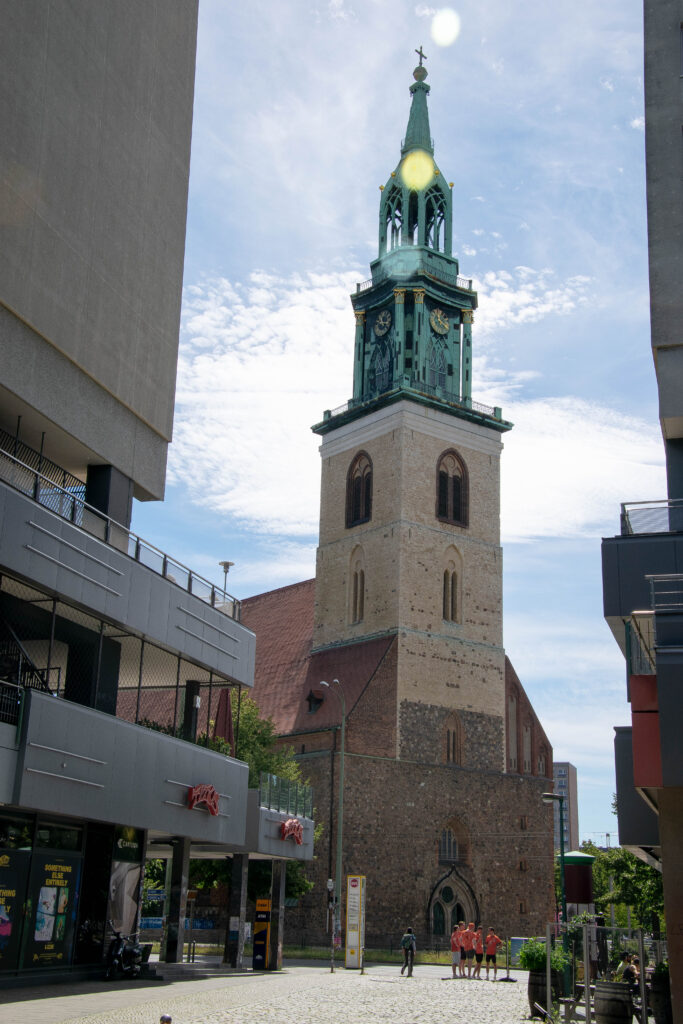
St. Mary’s Church plays an important part in the story of Berlin’s Jewish people, the church was the location where the first major act of anti-Semitism took place. In 1510, historical records indicate that 100 Jews were accused of stealing the church’s communion bread. 38 individuals were burned at the stake and two were beheaded and Jews all over the city were expelled. After the 30 years war in 1671, Friedrich Wilhelm invited Jewish families to resettle in Berlin thus founding one of the world’s most important Jewish communities.
Look closely at the pavement surrounding the church, and you will see a line of red bricks running through the cobblestones. These bricks outline the original foundation of the church building that stood here many years ago.
With your back to the church, cross over Karl-Liebknecht Strasse (there is a tram line in the middle of the avenue).
2. Former Gestapo Headquarters (currently home to a wine and coffee house)
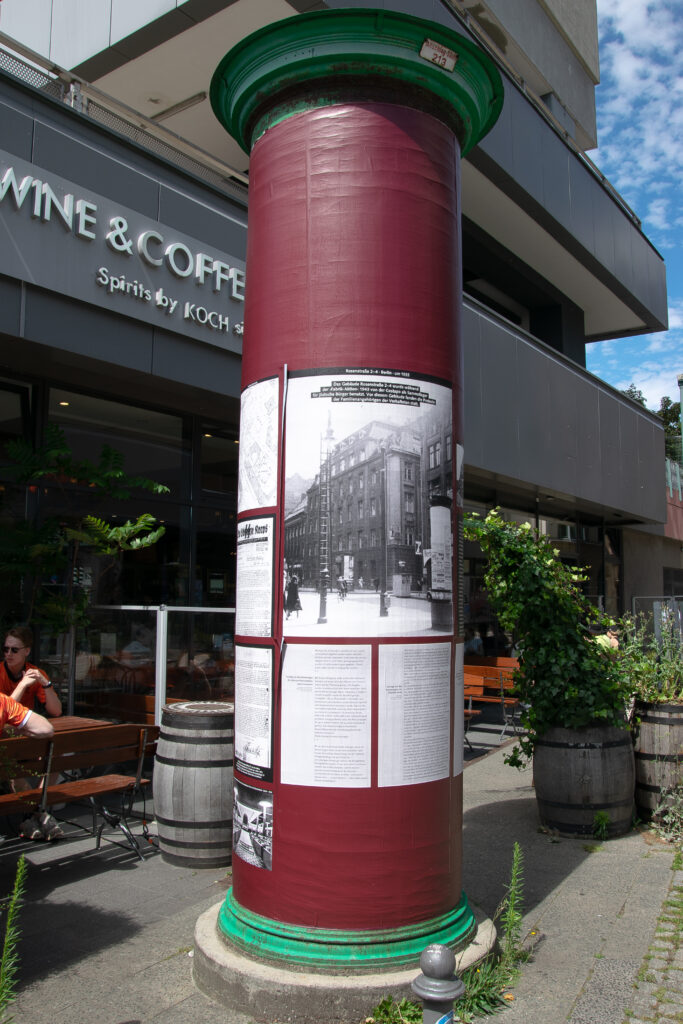
Prior to WW2, this site was the location a small neoclassical building that belonged to the Jewish community. In 1943, the building, after being taken over by the Gestapo, became the site of a historical event called the Fabrikation (Operation Factory). This event was the rounding up of many of Berlin’s last surviving Jews, who were brought to this location and held awaiting deportation to the camps. The red column which stands in front of the former building has photos of what the building originally looked like and important historical information for further reading.
Continue past this building towards the small alleyway and towards a small park with stone statutes. You should be walking on Rosenstrasse.
3. Rosenstrasse Memorial
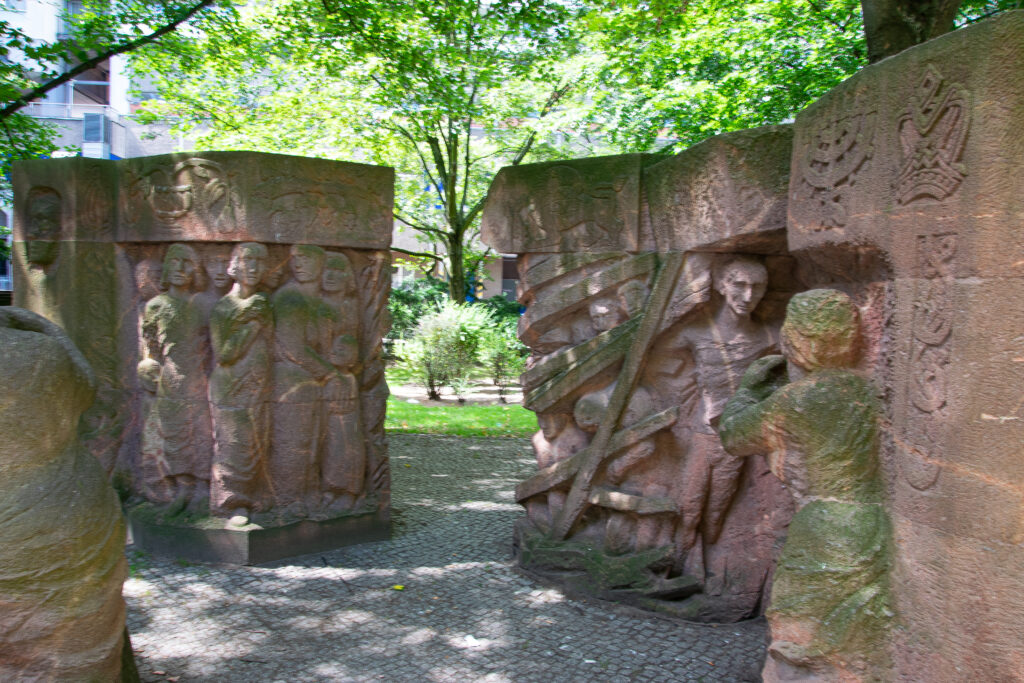
Most people visiting Berlin are unaware of the significance of this small quiet park. But this is the site of one of the most important historical events that took place in Berlin when some of its citizens courageously stood against the tyranny of Hitler’s Third Reich. As mentioned at our previous stop, in 1943 the Secret Police rounded up what they believed to be the last remaining Jewish people in Berlin. A majority of these people, roughly around 1,800 were considered to be privileged Jews, who were mixed race and/or who were married or engaged to German women.
On February 27, 1943, the wives, mothers, and daughters of these Jewish men, frightened for their loved one’s lives, made a daring last stand to save them. Their protest started small, but grew in number and they stood as one for days, only moving when air raid sirens were heard. The people of Berlin started to notice this protest and see the truth of who the Nazi party really were. Goebbels, the propaganda minister, tried to stem the news of the protest, but feared more Berliners would rise up with more wide scale protests, so he released the Jewish men to their families.
The stone sculptures in this park stand as a memorial to these valiant women. If you look closely, you will see a woman with raised fists breaking down the barriers that hold back the men. Behind the memorial are words written that translate, “The strength of civil disobedience, the vigor of love overcomes the violence of dictatorship; Give us our men back; Women were standing here, defeating death; Jewish men were free.”
As you leave the park, stop at the corner between the park and the Classik Hotel Alexander Plaza, here you will see a line of red bricks representing the outline of the Old Synagogue’s walls.
4. Site of the Old Synagogue
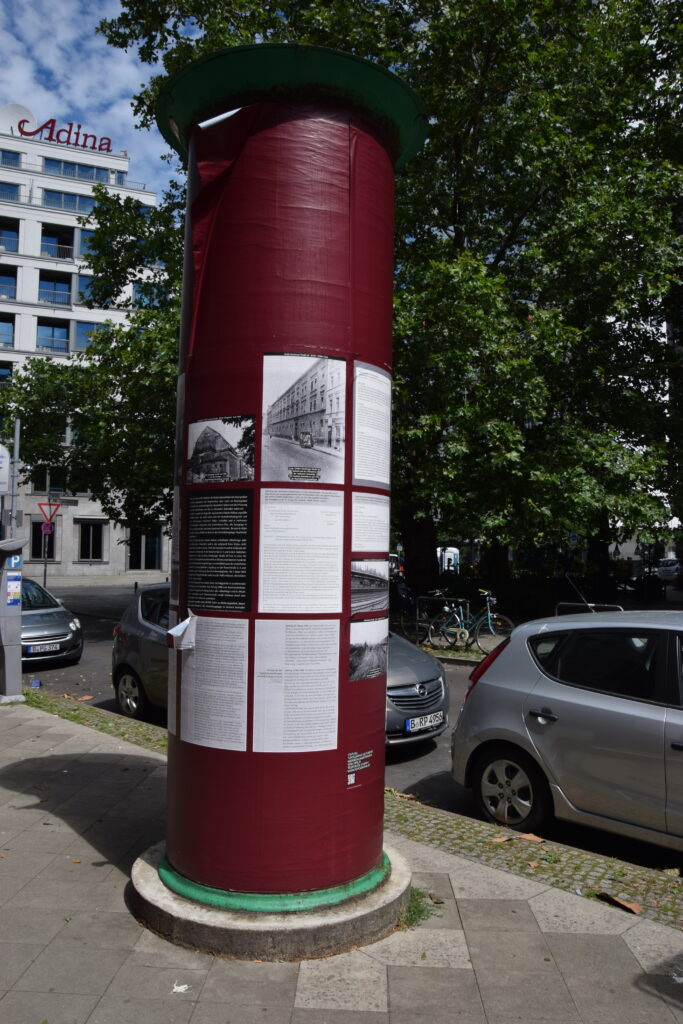
While no longer standing, the Old Synagogue, opened in 1714, was the heart of Jewish religious life. In 1854, the synagogue was redesigned to add a balcony so that women could pray. The Old Synagogue remarkably survived the destruction of Kristallnacht, but eventually was destroyed during the British air raids in 1945.
The column in front of the Classik Hotel Alexander shows pictures of what the Old Synagogue looked like. After learning about this important historical sites, make a right on Anna-Louisa-Karsch Strasse, and then make a quick left onto An der Spandauer Brucke walking towards the railway bridge in front of you.
Leaving Medieval Jewish Berlin and Discovering an Expanding Jewish Community
As you walk towards the next destination, it is important to note Berlin’s population was rapidly increasing during the 1800s, with the Jewish population growing to over 28,000 people. Needing more space to expand beyond the Rosenstrasse area, they starting settling in an area outside of medieval Berlin across from a small river. As the population and square footage of Berlin expanded, the city saw the need for a public transportation system and the idea to fill in the small river (which would also eliminate the need for residents to be ferried across it) came about because city planners didn’t want to displace a densely expanding Jewish population. Filling in the small river provided a place to build train tracks and the result connected the two sides of the Jewish community. As you pass under the bridge, you are entering the new Jewish area once known as the Scheuneviertel, or stables quarter.
Continue on An der Spandauer Brucke until you get to an intersection. Directly in front of you should be Hackeschen Hofe, our next destination. (Look for a Puma store near the courtyard entrance)
5. Hackescher Hof
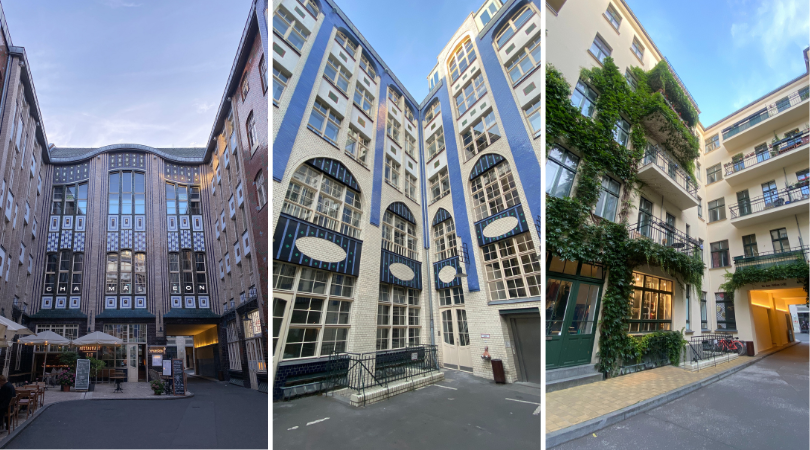
Enter through an archway with the words “Die Hackeschen Hofe” where you will be greated by a stunning collection of buildings connected by quaint courtyards. Unlike other areas of Europe, Berlin did not have a Jewish ghetto and Jewish citizens were granted special protections by the Prussians that would allow the Jewish people of Berlin the ability to thrive and create improved living conditions.
During the 19th century, Berlin had become so dense that it was known as being the world’s largest tenement and the Jewish section of Berlin was not immune to the squalid conditions created by the tenement style buildings. To combat overcrowded spaces and horrid living conditions, a new style of building emerged in Berlin known as Art Nouveau. The Hackeschen Hofe built in 1906, was designed to be a series of interlocking buildings connected by courtyards to help redesign city living.
As you spend time here, admire the art deco style buildings that were built to separate work, business, manufacturing, and daily family living. By providing separation, this design helped to curb the spread of airborne diseases. It was cutting edge design.
Entering the second courtyard, you can see how the apartments were built to provide a more peaceful living environment with trees, a fountain, and balconies incorporated into the buildings.
Continue walking through the third courtyard where you will find the Art Nouveau design of the Rosenhof by architect Hinrich Baller.
Exit through the archway named Zum Sophien Strasse and stop when you reach the street.
6. Sophienstrasse
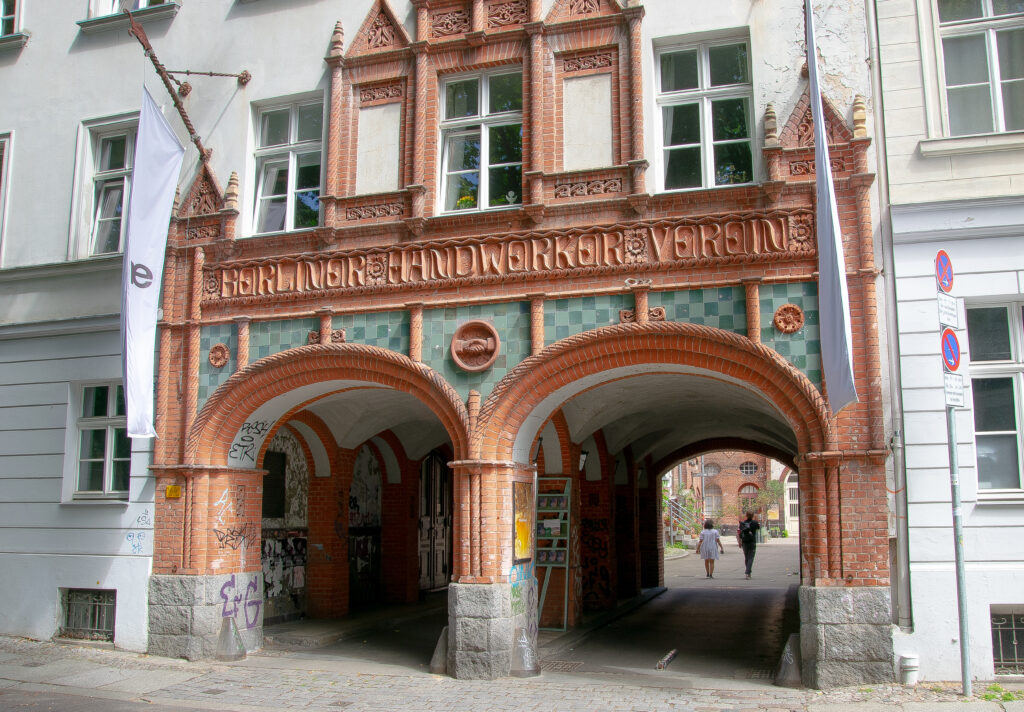
After exiting Hackeschen Hofe, you will be standing on Sophienstrasse, a street showcasing the original style of buildings in Berlin before Kaiser Wilhelm II made unifying architectural changes. As you turn right and walk towards the end of Sophienstrasse, we will give you a bit of history about the businesses once located on this street.
In April of 1933, Hitler initiated the persecution of the Jewish people but it wasn’t until 1935 when the Nuremberg Laws were published that Jewish people were denied citizenship, creating loopholes for their wealth to be stolen from them. A building on the left side of the street is an example of one such business that was taken from a Jewish family. This was the location of a thriving department store owned by the Wertheim’s, a prominent Jewish family, the department store was stolen from the family when they were forced to sell their business well below true market value. Other Jewish families’ businesses were shuttered when the Nazi’s marked their businesses as Jewish owned to keep “good” Germans from shopping there.
Look closely below the gutters on the buildings as you continue to walk and you will see stone carvings that represented the crafts and trades that once existed along this street. At the end of the street turn right onto Rosenthaler and walk towards our next destination.
7. Graffiti Alley
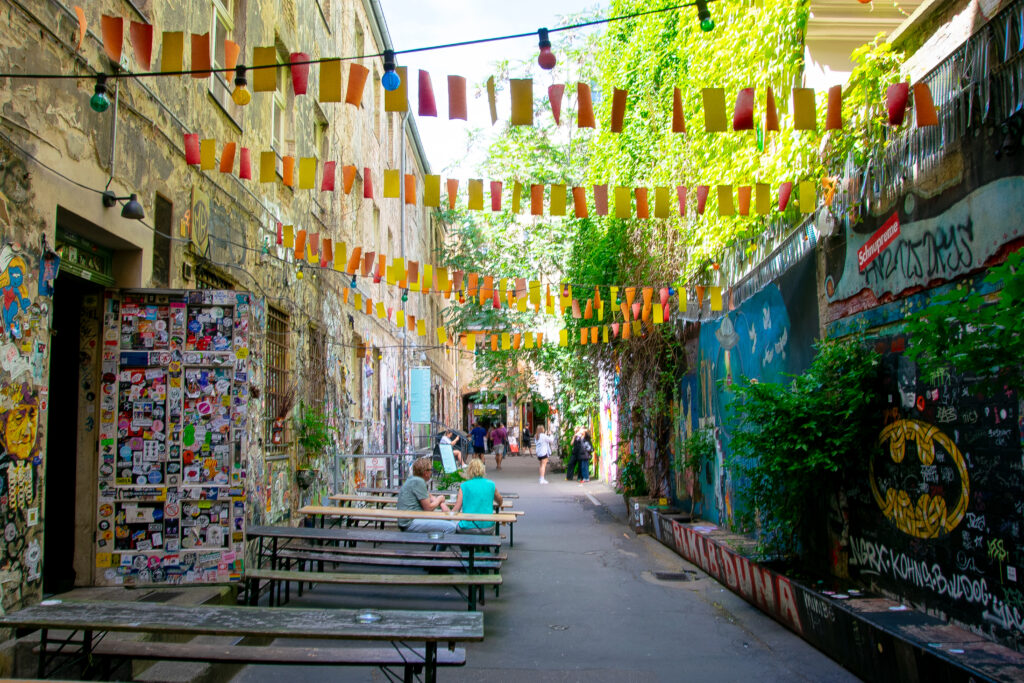
As you walk back towards Hacheschen Hofe, look for a small archway tucked in between the luxury shops. This small alleyway is one of Berlin’s hidden gems, home to colorful street art murals and smaller art pieces plastered to the walls. The small alley shows you what life was like back in the 1920s through the 1940s with tight quarters housing shops and small factories. It is now a colorful location made popular as an Instagram backdrop. But if you look beyond the gritty urban vibe, you will find this is the location of an incredible story.
Otto Weidt, whose image is depicted on the left side of the alley near a small set of steps, was a man who wished to protect his fellow man. With the rise of hatred under the Nazis increasing, the boycotting businesses, Kristallnacht, and persecution of Jewish people, Otto Weidt wanted to find a way to help the Jews in Berlin. In this alley, Otto founded a factory to manufacture paint brushes (an essential war product), giving him the ability to hire and protect Jewish workers. But he did not just hire any Jew to work in his factory, he hired Jews who were blind — knowing they were the most vulnerable and would be sent away to camps first. In 1943, the Gestapo had another great round-up and arrested all of Otto’s workers. Otto tried to buy their freedom, and was successful in saving many of his workers from being deported to Auschwitz.
Today the factory building contains a small, but important museum dedicated to his memory. Feel free to visit it or the Anne Frank Zentrum before continuing with the walking tour.
Continue Walking To Our Next Location
After exiting Graffiti Alley, turn right and continue walking until you reach Oranienburger Str and then make another right. From 1940 until the end of the war, the British air raids destroyed roughly 90% of Berlin’s historic center, including the Jewish district. As you walk along this street, take notice the way the new and old buildings seem to compliment each other.
As the war raged on, it was important for Berliners to seek shelter in the basements of buildings. Every building that adjoined another was mandated to have an escape hatch or wall that could easily be knocked down in case one building was destroyed, leaving access to the other basement to give citizens a chance of survival. Many of the older buildings still have traces of bomb shelters with steel and concrete doors, and can be recognized by the embossed words, “Luftschutzraum”, air raid shelter. See if you can find a few.
When you reach the corner of Grosse Hamburger Strasse, turn right.
8. Old Jewish Cemetery
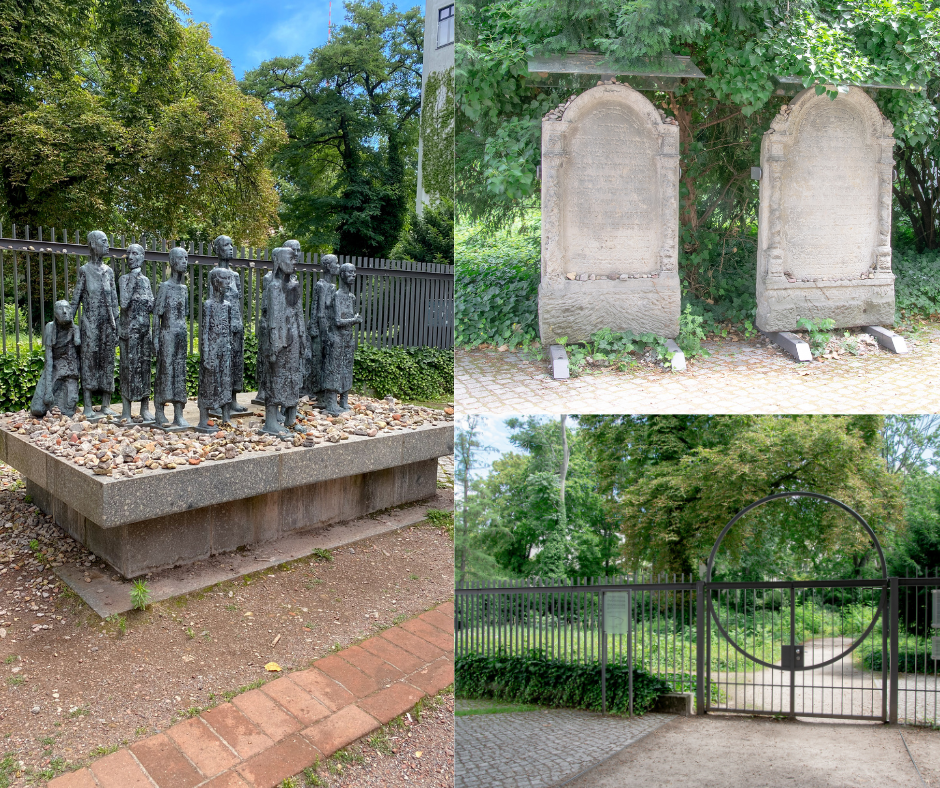
When you reach an iron gate and fence, you will have reached the site of Berlin’s Old Jewish Cemetery, one of the oldest Jewish sites in Berlin. In 1672, just one year after the Jewish people resettled in Berlin, this plot of land was given to them to create a Jewish cemetery. Notable Jewish leaders such as, Daniel Itzig and Moses Mendellsohn are burried here. During the war, the Nazi ideology of erasing the Jews from history took hold and they sought out to remove Jewish sites. If you look through the iron gates, you will notice that there are little to no headstones left. Prior to WW2, this cemetery had approximately 2,700 headstones.
Observe the floor and look for the lines of red bricks. These represent the walls of the former Jewish Old People’s home. During the war, the Nazi’s installed metal bars on the windows and used the building as a deportation center. The building was destroyed during the air raids of February 1945.
You will also notice a bronze statue featuring several women. This statute was created in 1957 and was originally housed in the former Ravensbruck concentration camp, a women’s only camp. It was moved to this location in 1985 to give the memorial more presence.
After a sober reflection, continue walking north.
9. The Missing House
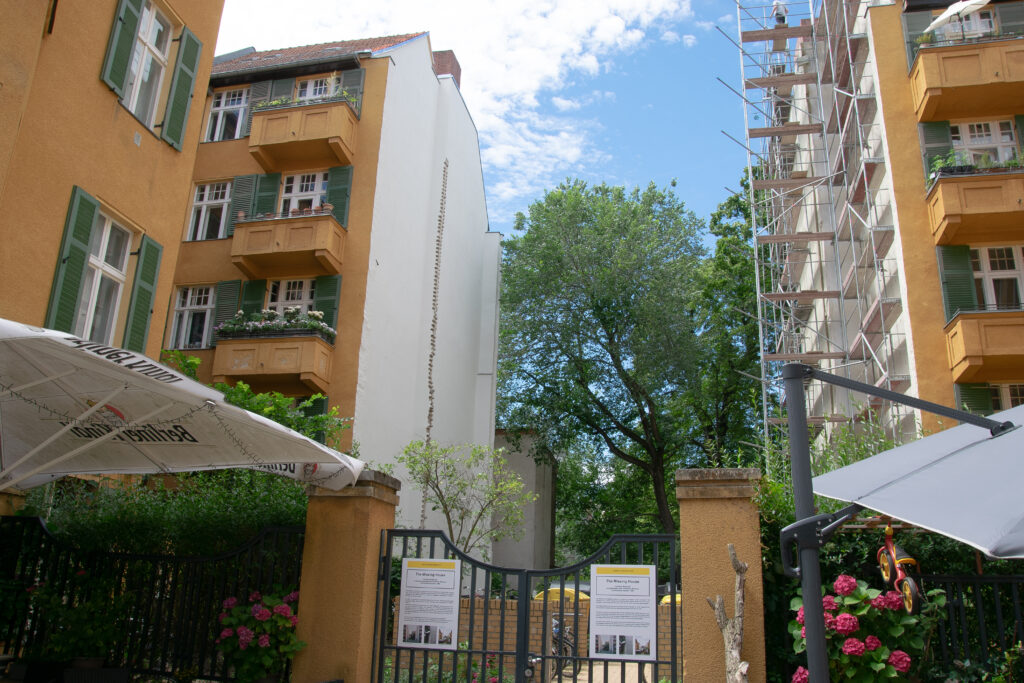
As you continue walking north, not far from the Old Jewish Cemetery, you will come to an unusual site. When you reach a vacant lot sandwiched between two restored yellow apartment buildings, stop and take a closer look. The Missing House is an art installation and a memorial to those lost during the air raids of WW2. Artist Christian Boltanski researched the former residents who lived in this apartment building and created plaques to record the family names and their occupations, all who were either killed or severely injured. Look at the walls of the two standing apartment buildings to see the names facing the vacant lot.
10. Sophien Church and
11. The Stumbling Stones
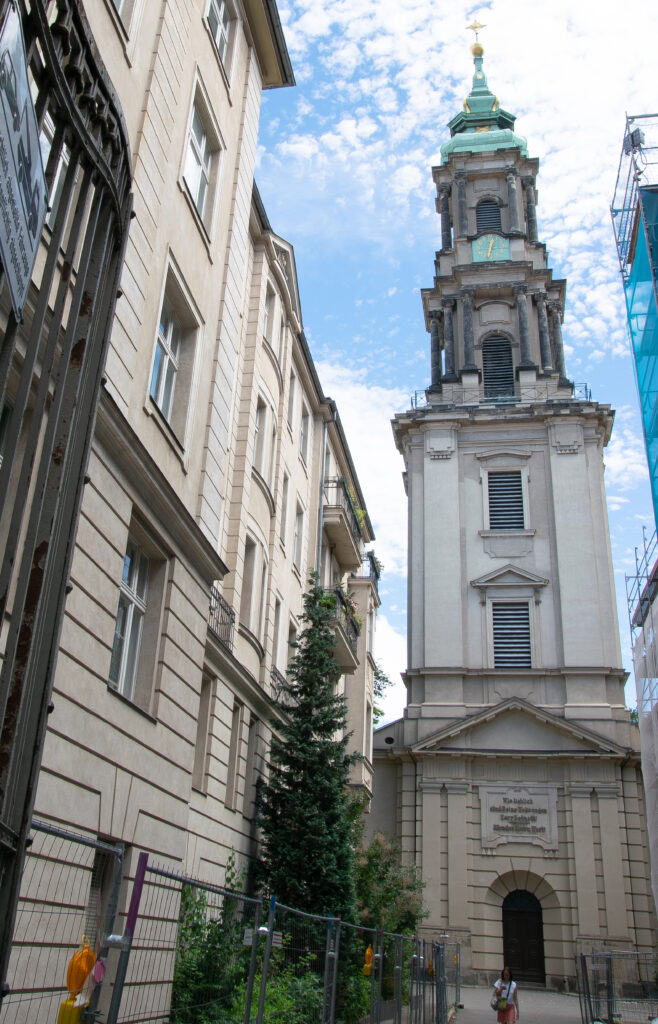
Continue your journey north for a few meters/feet, and you will come to an alley leading to a church. As you look towards the church glance towards your left and you will see a restored apartment building and then look at the building to your right. The building on your right is exactly like it was at the end of the war with bullet holes and other damage sustained when the Red Army invaded Berlin. There are only a handful of examples like this left in Berlin.
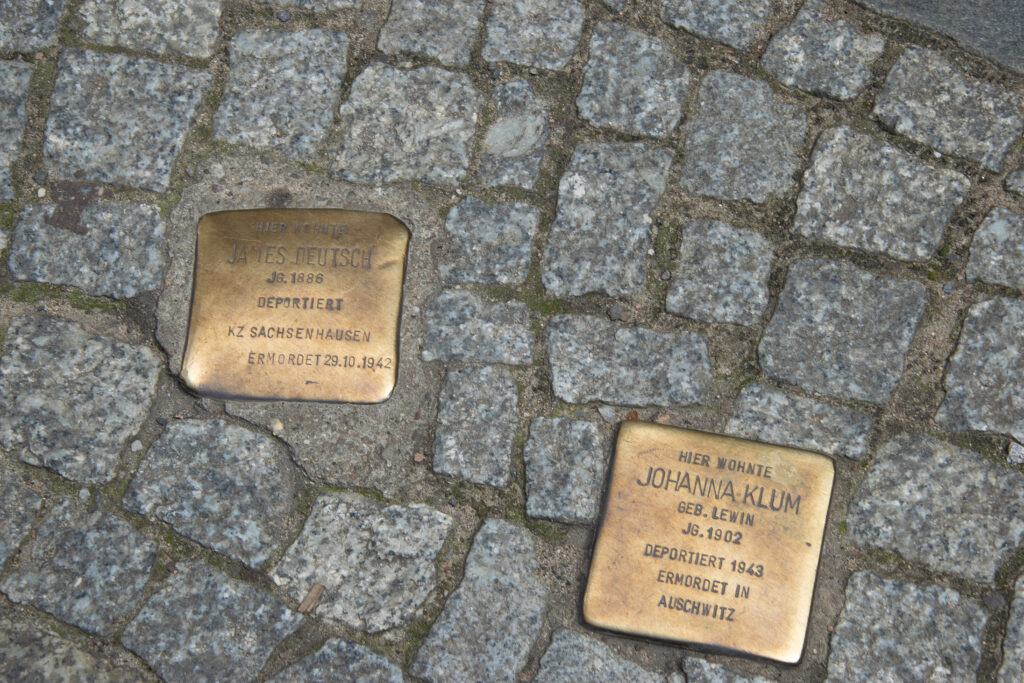
Directly to the north of the church in front of the restored apartment building stop and look for the bronze square bricks in the pavement. These are Stolpersteine, translated “stumbling stones” placed outside of the homes of Jewish people who were murdered by the Nazis. They are to remind us of the horrors inflicted on the Jewish people and for us to never forget it or we shall stumble again. There are over 15 of these blocks on this street alone, and over 2,800 embedded throughout Berlin. Look for them as you continue to walk the tour.
12. The Secret Bunker
Walk north for approximately 6-10 minutes until you reach Koppenplatz (a small park). If you look to where the children’s play area is, you will see a slight elevation in the ground. This is the location of a former forgotten secret bunker built in 1941 for the local NSDAP party leaders. After the end of WW2 the entrance was bricked up and then later destroyed in 1995. Walk to the end of the park where we will see another important memorial.
13. Kristallnacht Memorial – The Deserted Room
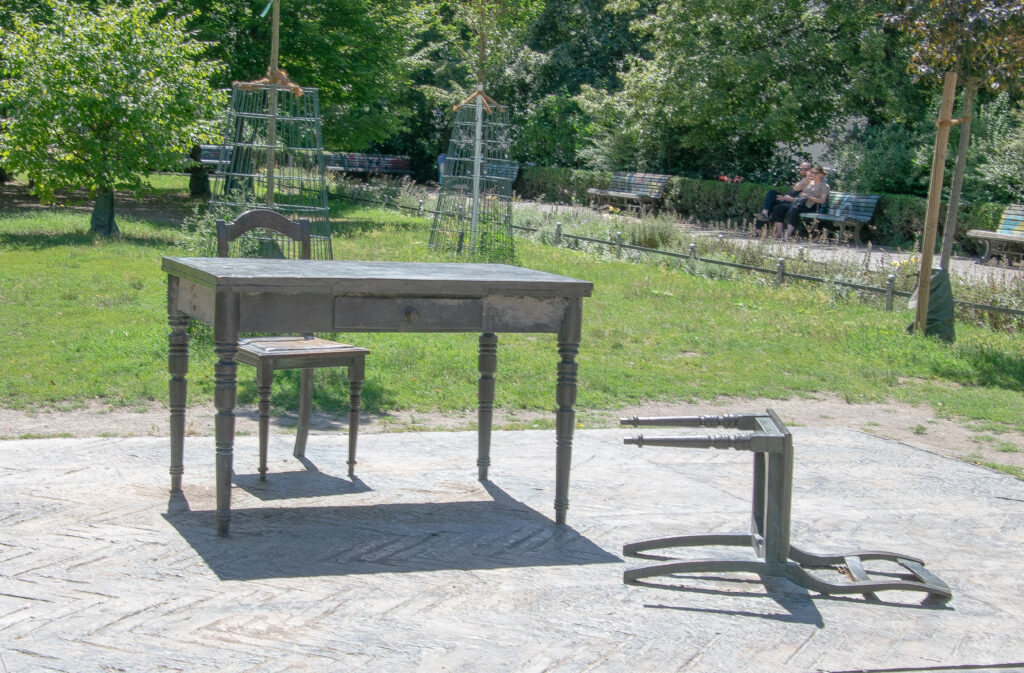
This memorial depicting a desk and chair with another overturned chair, called “The Deserted Room”, represents the empty rooms left behind by the Jewish people who were deported to concentration camps. It also serves as a reminder of the destruction to homes and businesses during the horrors of Kristallnacht. Over 91 Jewish people lost their lives during Kristallnacht. The damage from that night was so extensive that the former Kaiser Wilhelm II lamented, “for the first time, I am ashamed to be German”.
Take a moment and look at the bricks outlining the memorial and notice the poem written by Nelly Sacks. Translated it reads, “Oh the houses of death/invitingly appointed/for the landlord of the house who was once a guest/Oh you fingers,/laying the threshold/like a knife between life and death/Oh, you chimney stacks,/Oh you fingers,/And the body of Israel going up in smoke!
After spending time reflecting on these words, head back in the same direction you came from and walk until you reach Auguststrasse and then turn right.
14. Auguststrasse
This street is home to several of Berlin’s trendy and small art galleries. On the walls in front of a few of these gallery, there are painted yellow Andy Warholeque bananas, a symbol to let patrons know the gallery is good quality. See if you can spot them.
In addition to being home to a vibrant art scene, Augustrstrasse has several important historical landmarks to discover.
15. Clarchen’s Ballhouse
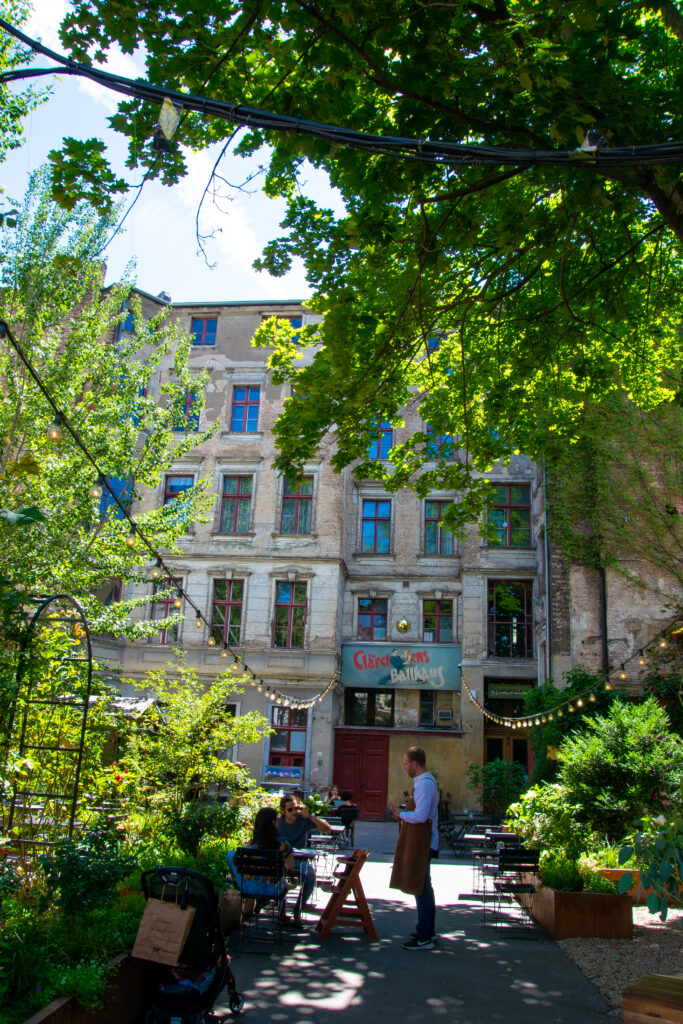
On the left side of the street, you will come to Clarchen’s Ballhaus, a historic building that was built in 1895 with two halls: the dance hall on the ground floor and a mirror hall on the upper floor. Clara Buhler opened Clarchen’s Ballhaus in 1913 and ran the dance hall during both the Nazi regime and the communist East German government era until her retirement in 1967. Although the front of the building was destroyed during WW2, the dance hall resumed operations after the war ended. In 1965, the ruins of the former front building were finally removed, leaving the area vacant. When Clara retired, she passed the business to her stepdaughter who ran it until the business was sold in 2003. Clarchen’s Ballhaus is only one of the 900 dance halls from the early 1900s that is still in existence. Today it is home to a restaurant and special events center.
16. The Jewish Hospital Building
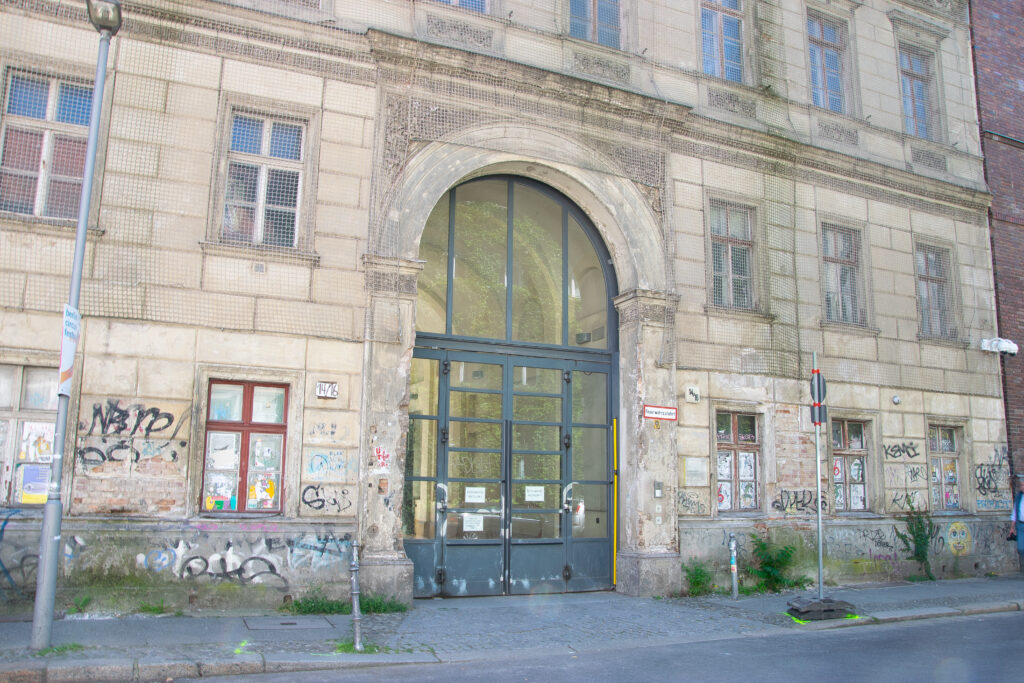
The next historic building you will come to is the former Jewish Hospital building. The Jewish community opened this hospital in 1861 and it was considered one of the most modern hospitals in Europe at that time. After only a half century, the hospital was no longer adequate to serve the community and in 1914 it closed and a newer hospital was built in another location to replace it.
After the end of WW1, the old hospital would serve a new purpose when several social welfare groups moved into the building including: the Jewish Children’s Relief Organization, the Ahawah children’s home, a kindergarten, a home economics school, and a student dormitory. The organizations housed in this building were able to provide care and treatment to an estimated 20,000 people every year until WW2.
17. Jewish Girl’s School
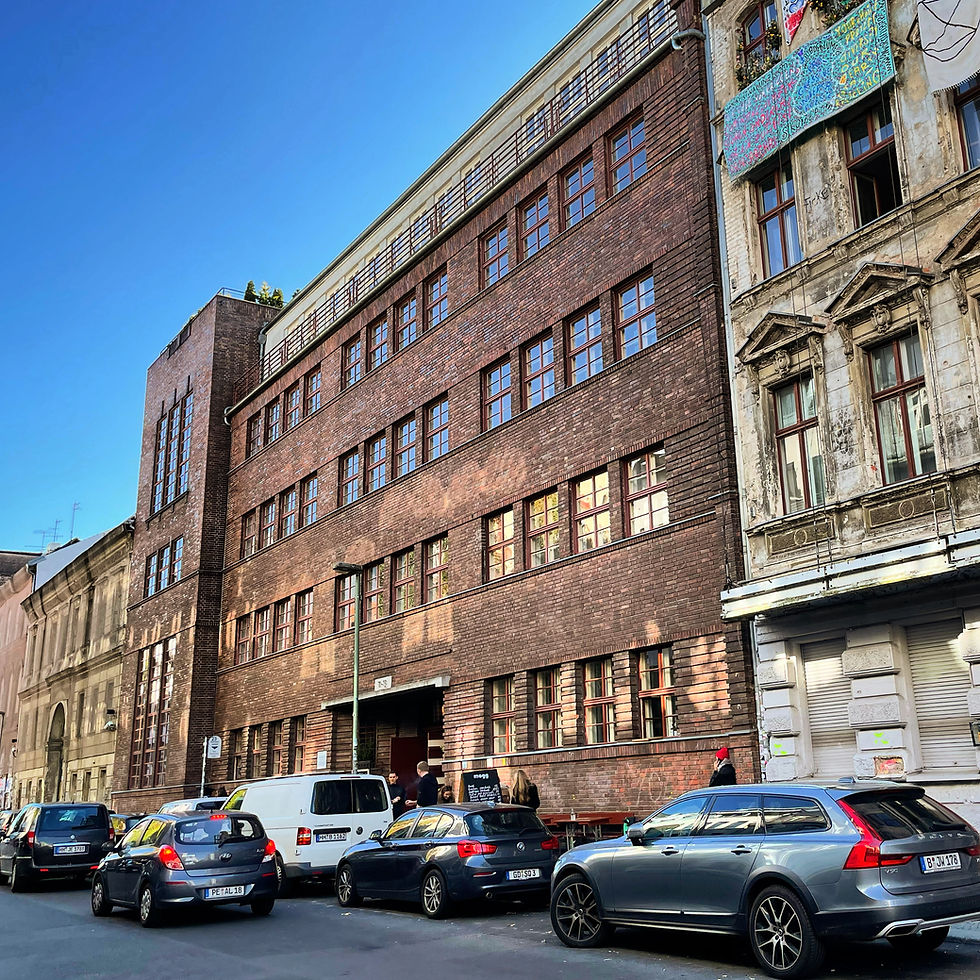
Next door to the former Jewish Hospital is the former site of the Jewish Girl’s school. The reddish brown brick building, designed by architect Alexander Beer, opened in 1929, providing an education to Jewish girls until 1942 when all Jewish educational institutions were closed by the Nazi government. Sadly, most of the school’s female students were deported to Auschwitz and murdered.
After the war’s end, the school briefly reopened to students in 1950 but closed again in 1996 due to a lack of enrollment. Today, the building houses the Michael Fuchs gallery and is home to the world’s second largest Kennedy exhibition. Feel free to spend time in this important gallery before continuing to the next location.
18. Heckmann Hof
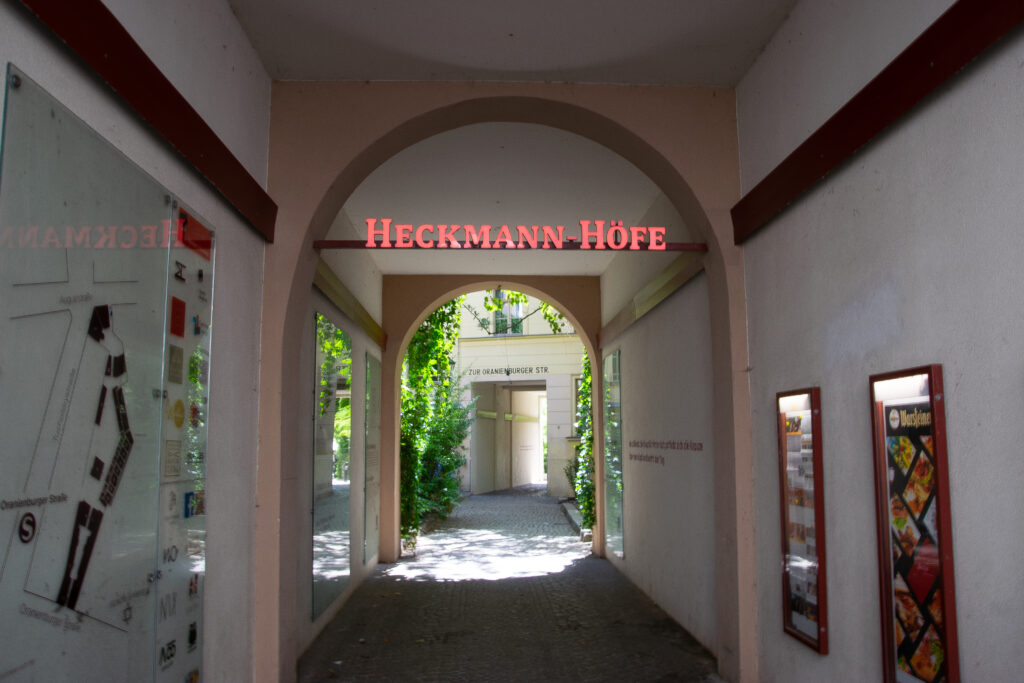
Continue walking along Auguststrasse for a few more meters/feet until you reach an opening to a series of courtyards. Look for the words “Heckmann Hofe”. This courtyard is a typical example of the old courtyards that were prominent in this neighborhood during the early 1900s. The lovely cafes and shops lining Heckmann Hofe were once were used as stables. The red brick building in the middle of the courtyard was a former coach house.
As you walk through this courtyard area look up and you will see the beautiful dome of the New Synagogue. Our tour is almost finished, so if you haven’t stopped along the way for a break, this is a beautiful spot to do so.
19. New Synagogue
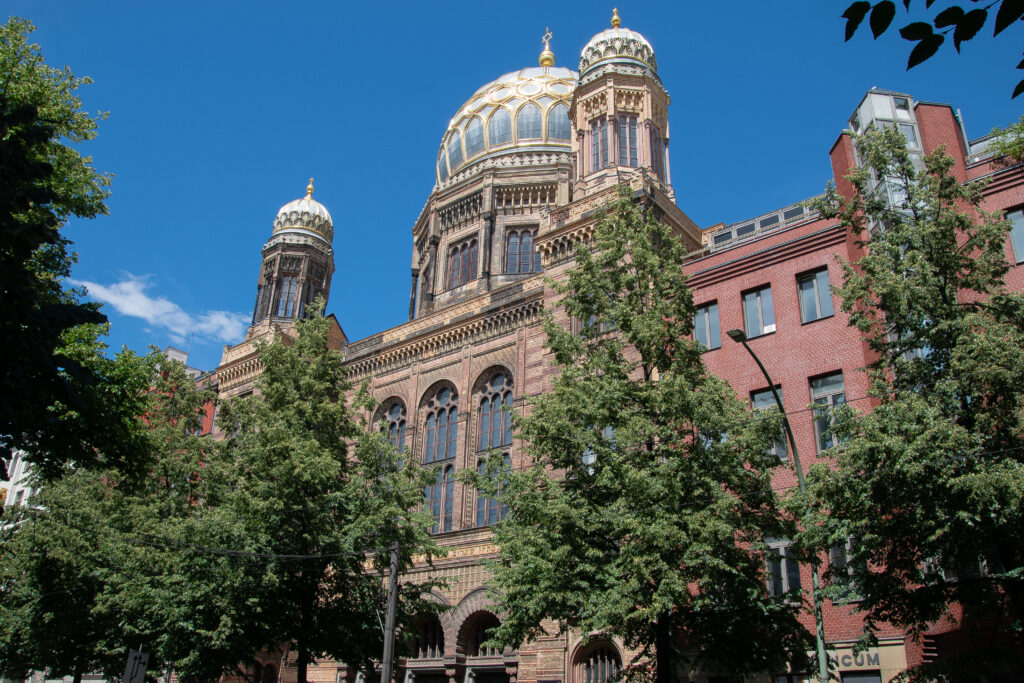
As you exit Hechmann Hofe, turn right (you will be on Oranienburger Str.). Keep walking until you get to the front of the New Synagogue. For the best views of this magnificent building, cross the street. The New Synagogue represents the past, the present, and the future of Berlin’s Jewish community. As the Jewish population expanded in the 1800s, the Old Synagogue, located on Rosenstrasse, was no longer capable of hosting the growing community, so a new synagogue was soon built. With a capacity to hold 3,200 people, the New Synagogue would become Germany’s largest synagogue. When it opened in 1866, Prussian Iron Chancellor Otto von Bismarck helped to welcome in the synagogue and mark its importance to not only the Jewish community but to the entire Prussian empire.
The building survived Kristallnacht due to the courageous efforts of a Berlin Policeman named Otto Bellgardt, who forced out Nazi arsonists in order to protect the building, putting his life at risk. The synagogue was forced to close in 1942 when the Nazis took it over and used it to store German uniforms. In 1943 the New Synagogue was destroyed. For decades the synagogue lay in ruins until the soviet control of the city was coming to an end. In 1988, the rebuilding of the synagogue took place. Today, the New Synagogue serves as a museum and a prayer space for a new Jewish generation that has grown from the 4,000 who remained after the war, to 10,000 Jewish people living here today.
The end of our walking tour
While the neighborhood you just explored was the epicenter of Jewish life, our tour highlighted a fraction of Berlin’s deep Jewish history roots. If you want to experience more Jewish history, we recommend visiting the following: The Memorial to the Murdered Jews of Europe, the Jewish Museum, the Topography of Terror, Gleis 17 Memorial at Grunewald Station, and Anhalter Bahnhof (the ruins of a former train station now serving as a memorial to the Jews deported from Berlin).
Follow the map below to visit all of the sites listed in this article.
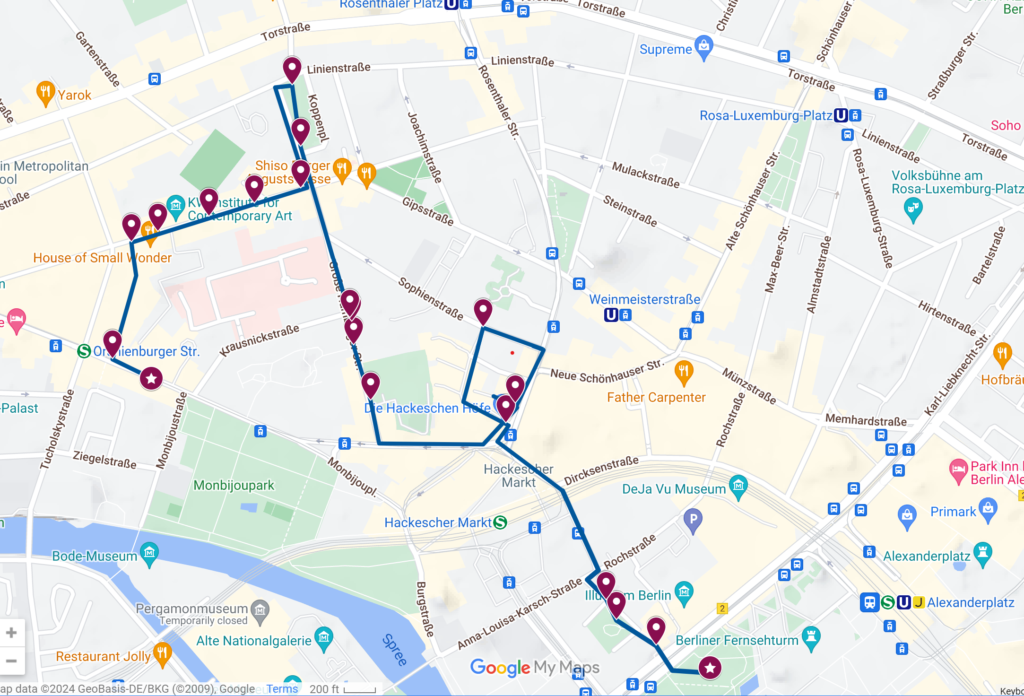
Be sure to book mark this article and use it as a guide to explore this vibrant neighborhood the next time you are in Berlin.